Decumbent swordplant

Echinodorus decumbens
Decumbent swordplant
- Narrow-leaved solitary plant
- Natural appearance
- Warmth tolerant, suitable for Discus tanks
Item question
We’re here for you!
Please enter your question and e-mail and we’ll contact you as soon as possible. It usually takes us up to 24 hours during business days to respond.
Thank you for your question!
Thank you, we’ll get in touch!
Close window
You already sent us a question.
Please wait a few minutes
Description
Echinodorus decumbens is a very narrow-leaved wild type from Brazil. It was discovered by Christel Kasselmann at the Surubim river in eastern Brazil and also scientifically described by her. Until now this sword plant is only known from the original location. Since the 1990s it has been widely spread in cultivation, however it is not very familiar to the hobbyists and not often available in recent times.
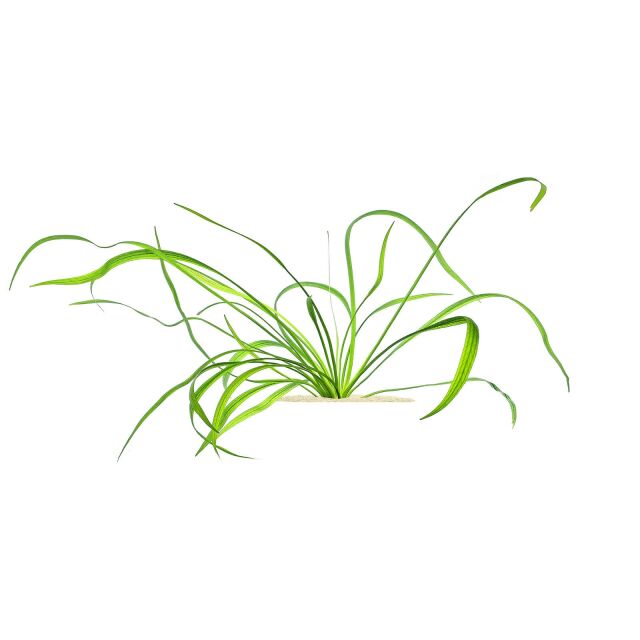
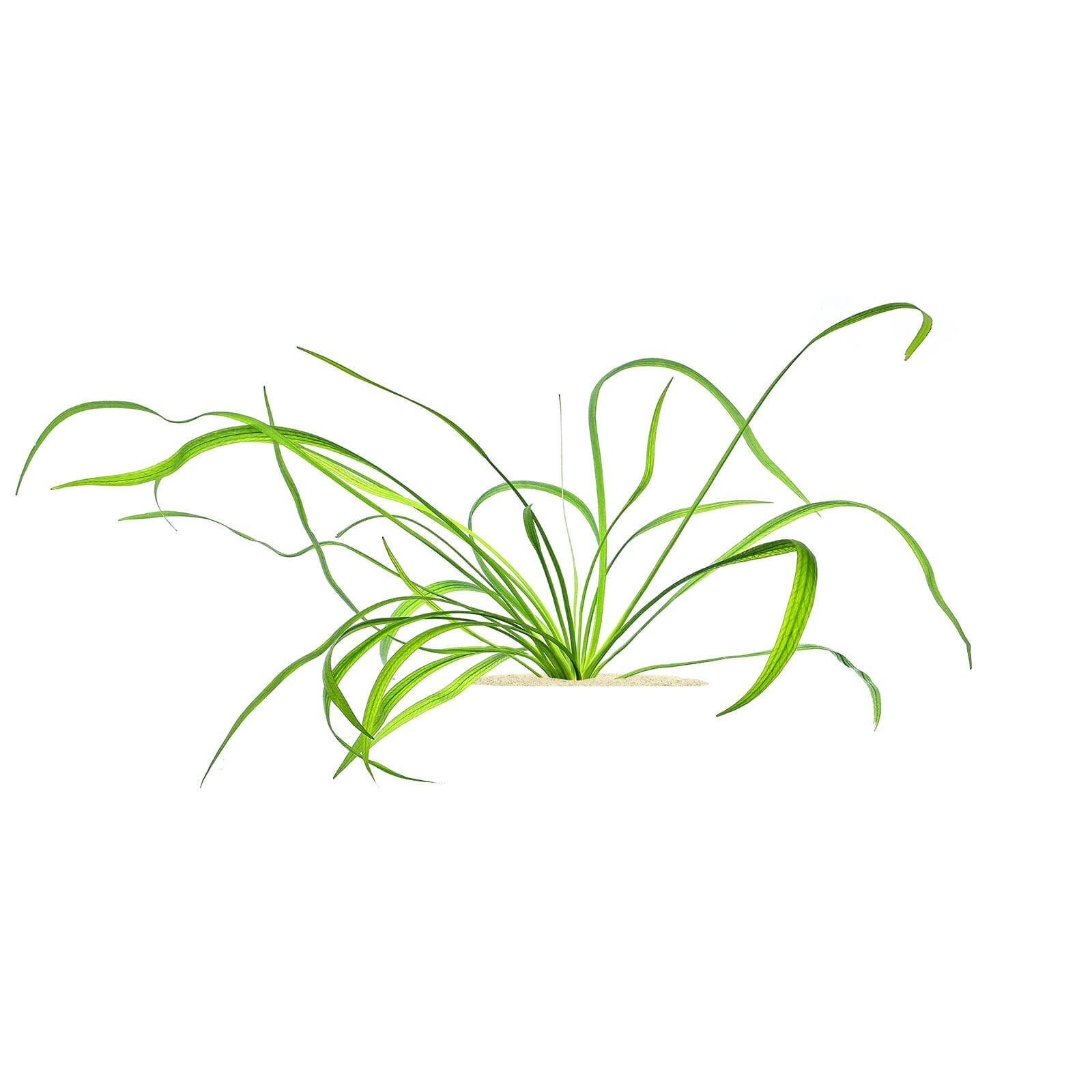
This close relative of Echinodorus subalatus and E. palifolius develops in its submerged form very narrow, almost linear, freshly green, slightly transparent leaves and gets about 50 cm tall. It is named after the decumbent growth of its long inflorescences.
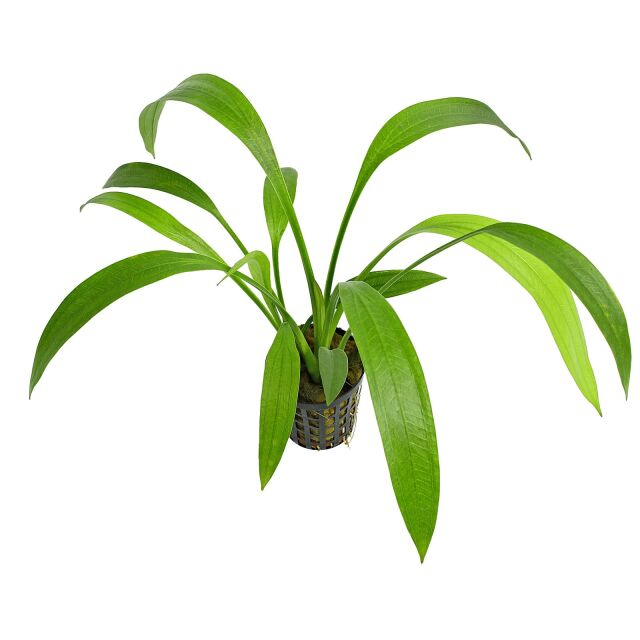
As virtually all Echinodorus, this species prefers a nutrient-rich substrate and medium to strong lighting. It has no special demands and grows also well in medium hard water. Due to its origin in a hot region of Brazil, Echinodorus decumbens tolerates high temperatures around 30 °C, so it's suitable for Discus tanks. Its growth is not very fast. It is propagated by adventitious plantlets on the inflorescences which appear mostly in the emersed form, but sometimes also in the aquarium. As usual with Echinodorus from water plant nurseries, it is mostly delivered in its terrestrial (emersed) form with considerably broader, lanceolate leaves. Planted into the aquarium, its much narrower submerged leaves will appear.
The Decumbent swordplant deserves much more attention in the aquascaping. In complete contrast to many colourful and broad-leaved Echinodorus cultivars, this wild type has a modest, natural appearance, with its very narrow, green leaves. It sets vertical accents as specimen plant or small group in the mid- or background and is well combined with small-leaved stem plants. Especially for South America-themed biotope tanks, Echinodorus decumbens is an appropriate plant. As emersed plant in paludariums, this species looks decorative with its lanceolate, arching foliage.
In 1994, Echinodorus decumbens was discovered by Christel Kasselmann on Rio Surubim in the eastern Brazilian state Piauí. Later on it was scientifically described by her, too. Up to now, this species has only been found in that location, where it grows directly on the banks as well as in indundation zones of the river. Once imported into Germany, E. decumbens was cultivated and quickly spread in the hobby; today, it is frequently offered in trade.
Its scientific name means "low-lying sword plant", which only refers to its decumbent, i.e. creeping flower stalks; the leaf rosette has an upright growth habit.
E. decumbens is closely related to E. subalatus, and its emersed form differs from it - amongst other characteristics - by its decumbent (instead of upright) flower stalks, which grow distinctly larger than the leaves and whose flower whorls grow at larger distances. (read more)
| Complete botanical name | Echinódorus decúmbens Kasselmann |
| Family | Alismataceae |
| Genus | Echinodorus |
| Difficulty | easy |
| Usage | Background, Midground |
| Height | 30 - 50cm |
| Width | 10 - 30cm |
| Growth | fast |
| pH value | 5 - 7 |
| Temperature tolerance | 18 - 30°C |
| Carbonate hardness | 0 - 21°dKH |
| General hardness | 0 - 30°dGH |
| Propagation | Proliferating inflorescences |
| Can grow emersed? | yes |
| Source | Flowgrow |
| Complete botanical name |
| Echinódorus decúmbens Kasselmann |
| Family |
| Alismataceae |
| Genus |
| Echinodorus |
| Difficulty |
| easy |
| Usage |
| Background, Midground |
| Height |
| 30 - 50cm |
| Width |
| 10 - 30cm |
| Growth |
| fast |
| pH value |
| 5 - 7 |
| Temperature tolerance |
| 18 - 30°C |
| Carbonate hardness |
| 0 - 21°dKH |
| General hardness |
| 0 - 30°dGH |
| Propagation |
| Proliferating inflorescences |
| Can grow emersed? |
| yes |
| Source |
| Flowgrow |
General information
Please choose a variant to see more information.
| Item no. |
|
| EAN | |
| Weight | |
| Shipping weight |
Customers ask customers
You have questions about this product? Ask other customer or our support team about this product!
Customer reviews
One review
| 5 Stars(1) |
|
| 4 Stars(0) |
|
| 3 Stars(0) |
|
| 2 Stars(0) |
|
| 1 Star(0) |
|
My aquarium is 50cm tall, so have high hopes for these ones. Ordered 2 pots, but both pots had 2 plants, so Im extremely happy :D All plants were in very good condition and my... (read more)